Experience and Learn
Virtual Museum Experiences – History Comes Alive
Exhibits come to life, history becomes tangible: EDBYTO makes your collection digitally experiential. Visitors explore exhibitions in 3D, interact with virtual objects, immerse themselves in past eras – directly in the browser, no app download. WebXR technology connects preservation with education. Visitors experience culture firsthand, museums expand their reach, exhibits remain protected.
Interactive 3D tours foster understanding and emotional connection. Virtual museum experiences transform history into an immersive journey and reach every visitor – regardless of location or equipment.
In a free consultation, we’ll show you how to stage your collection digitally.
From static exhibit to living exhibit.
Museums face a fundamental dilemma: visitors want to touch exhibits to truly understand them – yet historical objects must remain protected. The Ashmolean Museum proved this dramatically*: After eight million touches, test objects showed severe degradation. Fabric was completely worn, metal developed patina, stone was polished shiny.
The solution lies not in stricter prohibitions, but in intelligent technology. Visitors explore historical printing presses, ancient tools, or fragile artifacts in full detail – without endangering the original. EDBYTO transforms virtual museum experiences into a stage for “Hands-on History“.


Live Demos – Four Ways to Experience One Exhibit
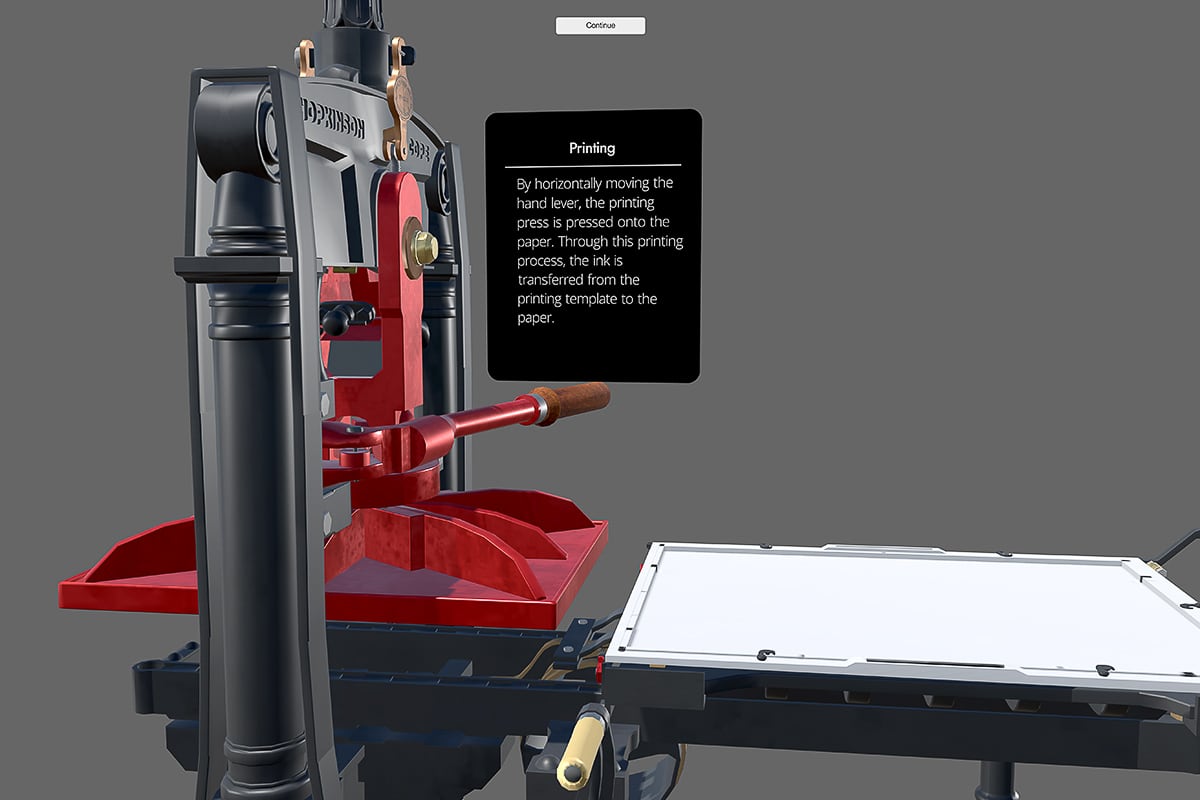
The historical Albion printing press No. 6551 from the 18th century demonstrates the versatility of WebXR in cultural education. One 3D model, four fundamentally different experiences – each with unique strengths for different educational goals.
AR/VR Mode brings the exhibit directly into real life: On AR devices, the massive machine appears true-to-scale in your own space – historical technology becomes tangible. With VR headset, you dive into the virtual exhibition room and explore mechanics from perspectives impossible in the museum. Network capability transforms individual exploration into shared discovery.
Interactive Video guides systematically through complex relationships: A curated camera path with audio track directs attention to central details. Clickable hotspots open deeper information – without losing control. The object can be freely rotated at any time, the space freely explored, and the video continued at will.
Linear Video documents like a classic explainer film: Predefined perspectives show components and functions step by step. Complex workflows become comprehensible – with the flexibility to pause anytime and study details.
Scrollytelling synchronizes the sequence with user movements: Animations respond to scrolling or swiping. The historical printing process unfolds intuitively at your own pace, forward and back – the narrative remains guided, the tempo self-determined
Functional Modules for Captivating Exhibition Experiences
Coordinated functions make the difference: 3D interaction, network features, and innovative storytelling transform static exhibits into vibrant experiential and knowledge worlds – creating modern virtual museum experiences.
Bringing Exhibits to Life
Historical printing presses turn under your fingers, antique mechanics reveal their inner workings, invisible processes become visible. 3D interaction turns the Virtual Museum into a discovery space – on touch screens in the exhibition, tablets on guided tours or your own smartphone.
- Simulate historical machines realistically
- Visualize complex processes clearly
- Gamification awakens curiosity and emotional connection
- Self-determined learning pace promotes sustainable understanding
- Cross-platform usability

Boundlessly Real
AR brings exhibits and enhanced digital information directly into the real environment: Ton-heavy steam engines appear true-to-scale in classrooms, scientific visualizations overlay physical objects. VR goes further: Complete immersion in reconstructed historical locations that have long disappeared or were never accessible.
- True-to-scale AR projections in your own space
- Make scientific concepts understandable through interactive AR elements
- VR reconstructions of inaccessible historical sites
- Immersive experiences create emotional connections to history and culture
- Barrier-free: Full participation even with limited mobility

Learning Films Reimagined
Linear 3D films guide systematically through complex relationships – like classic explainer videos, only spatial. Nonlinear videos go further: Camera movements pause, visitors explore details freely in 3D space, different time layers and “what-if” scenarios become seamlessly experiential. Atmospheric sound design enhances immersion.
- Predefined camera paths for guided knowledge transfer
- Synchronized audio layer: Explanatory text, music, or original recordings accompany visual narrative
- Free 3D navigation during pause moments
- Integrate time layers and alternative scenarios seamlessly
- Content updates directly in 3D scene – without reproduction
- Implement multilingual versions flexibly for your virtual museum experiences
Scrolling Through Time
Animations follow your own movement: Scrolling or swiping controls narrative flow. Historical processes unfold at self-determined pace, complex processes become comprehensible step by step. Text, image, video, and 3D models merge seamlessly – the narrative remains guided, timing determined by the visitor.
- Intuitive control through natural gestures
- Individual learning pace: forward, back, pause as needed
- Deeper insights exactly where interest emerges
- Seamless integration of all media formats
- Optimal display on desktop, tablet, smartphone

Discover Together, Share Experiences
Museum tours across continents: Experts guide groups through virtual museum experiences while participants explore exhibits together – each from their own space. Integrated video conferencing, virtual pointer, and screen-sharing make collaborative learning seamlessly possible.
- Virtual group visits promote shared learning
- Experts offer worldwide tours in real-time
- Virtual pointer and drawing pen for precise explanations
- Screen-sharing for documents and supplementary materials
- Synchronous interaction: Everyone experiences the same simultaneously

Working with EDBYTO


1
Project Start
- Initial Contact – non-binding and free
- Kick-off Meeting – foundation for successful implementation
- Needs Assessment – initial overview of goals and scope
- Stakeholder Analysis – who is involved, who decides
2
Concept and Planning
- Requirements Analysis – define technical and content requirements
- Detailed Project Planning – milestones, timeframe, resources
- UX Concept – user guidance, interaction design, user journeys
- Technology Selection – optimal technical foundation for your goals
3
Design and Development
- UI Design – visual design of user interface
- 3D Data Capture – photogrammetry, scanning, or 3D modeling
- Frontend Development – graphic interface and interactions
- Backend Development – technical foundation and data management
- System Integration – seamless integration into existing infrastructure
- Quality assurance and testing – continuous testing and performance optimization
4
Launch and Support
- Implementation – gradual integration into existing processes
- System Handover – smooth transition to production
- Employee Training – practical instruction for your team
- Technical Support – reliable support during operation
- Content Updates – updating and expansion as needed
- Performance Monitoring – continuous application optimization
- Optional Further Development – new features and functions with growing requirements
Have an Exciting Project Idea?
Perfect. We’ll analyze with you how WebXR can enrich your project – concrete, direct, to the point. Schedule a free initial consultation with us. Briefly describe your project in the form or contact us directly – we look forward to realizing your virtual museum experiences together with you.